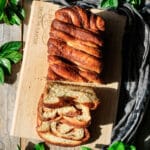
Cinnamon Babka
This delicious Jewish sweet bread is soft and fluffy, and tastes exactly like a cinnamon roll! Learn how to make cinnamon babka with this easy bread recipe.
Servings: 1 large loaf (12 slices)
Calories: 420kcal
Ingredients
For the Dough
- ½ cup whole milk
- ½ cup filtered water
- 4⅛ cups bread flour such as King Arthur
- 3 teaspoons fast-action yeast
- 2 teaspoons table salt
- ⅓ cup granulated sugar
- 2 large eggs
- 1 large egg yolk
- 10 tablespoons unsalted butter softened
For the Filling
- 1 cup light brown sugar packed
- 2 tablespoons all-purpose flour
- 4 teaspoons ground Saigon cinnamon
- 4 tablespoons unsalted butter softened
For the Syrup
- ¼ cup granulated sugar
- ¼ cup filtered water
Instructions
Day #1: Make the Dough
- Pour the milk and water into a small saucepan and heat over medium heat until the mixture reaches 115°F, stirring frequently.
- Dump the flour into the bowl of a stand mixer and add the salt and yeast on opposite sides of the bowl, then stir in each one with your finger. Keeping the salt separate from the yeast prevents it from killing the yeast.
- Add the sugar, eggs and yolk, and softened butter and mix on low speed with the paddle attachment until a dry, clumpy mixture forms. Gradually trickle in the warm milk and water mixture to form a soft, flexible, but not sticky dough. (I only used ⅔-¾ cup of the mixture, but the exact amount needed will vary based on the brand of flour, its protein content, and the humidity.)
- Cover the bowl and let it rest for 30 minutes.
- Use the hook to knead the dough on medium-low speed until it passes the windowpane test, about 2-3 minutes. The windowpane test means that you can stretch a lump of dough thin enough for it to be translucent without tearing. If it fails the test, knead for 1 minute longer and check again.
- Shape the dough into a ball and cover with plastic wrap. Let it prove in the fridge for at least 8 hours. (I left mine in the fridge for almost 21 hours, but don't go beyond 24 hours.) During this stage, the dough will rise, but harden up quite a bit. This long, slow prove builds a great flavor in the dough and makes it easier to handle later.
Day #2: Making the Babka
- Place the bowl of chilled dough in a warm place for 1 hour to make the dough warmer and more pliable.
- While the dough is warming, prepare the filling by mixing all the ingredients in a bowl to form a smooth paste. If it is too dry to spread easily, add an extra tablespoon of softened butter.
- Punch down the dough and roll it out into a 9x24-inch rectangle. Spread the filling on the dough, leaving a border one inch all the way around.
- Roll the dough into a tight log like a roulade, starting from one of the long sides. Pinch the seam and ends to seal.
- Use a sharp knife to cut the log in half lengthwise, then turn the two halves so the filling faces upwards. Twist the two lengths together, keeping the filling side up.
- Place the bread in a parchment-lined 9x5-inch loaf pan, tucking the ends under, and cover with plastic wrap. Let the loaf rise until it has crowned above the edge of the pan and slowly springs back when prodded with a fingertip, about 1 hour at room temperature.
- About 30 minutes before the loaf is done proving, preheat the oven to 350°F.
- Bake the babka at 350°F for 50 minutes. It should be well browned and have an internal temperature of 190°F on a meat thermometer when it's done. Check it frequently and cover with foil after the first 20 minutes if it starts getting dark.
- While the babka is baking, combine the granulated sugar and water in a small saucepan over medium heat until the sugar has dissolved. Set aside.
- Brush the babka with all of the sugar syrup. While this step is optional, it does improve the babka’s moisture and helps it stay fresh longer.
- Let the babka cool for 15 minutes in the tin. Remove it from the tin and place on a wire rack to cool completely, about 1½-2 hours. Slice and serve.
Notes
- Don't skip the 30-minute rest. This helps the dough have a better rise and texture and reduces the kneading time.
- Don't omit the flour from the filling. This ingredient helps the dough stick to the filling as it rises and bakes, preventing big gaps inside. You can reduce gaps even further by brushing the dough with egg wash before spreading on the filling.
- Want two loaves instead of one? Divide the dough into two pieces after it's warmed up on Day #2, roll into smaller rectangles, then proceed with the recipe as written. You will need to shorten the baking time by probably 15-20 minutes.
Nutrition
Serving: 1slice | Calories: 420kcal | Carbohydrates: 62g | Protein: 8g | Fat: 16g | Saturated Fat: 9g | Polyunsaturated Fat: 1g | Monounsaturated Fat: 4g | Trans Fat: 1g | Cholesterol: 83mg | Sodium: 420mg | Potassium: 131mg | Fiber: 2g | Sugar: 28g | Vitamin A: 499IU | Vitamin C: 1mg | Calcium: 52mg | Iron: 1mg
