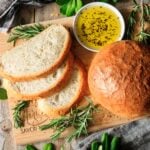
Macaroni Grill Bread Recipe
This crusty Italian rosemary bread tastes like the rustic loaves from Macaroni Grill. Use this amazing homemade bread for sandwiches, or just dip into olive oil for a simple comfort food snack. This recipe is sure to be a huge hit with your family!
Servings: 24 slices
Calories: 118kcal
Ingredients
For the Bread Dough
- 4¼ cups bread flour
- 3 teaspoons fast-action yeast
- 2 teaspoons salt
- 2 teaspoons granulated sugar
- 8 teaspoons dried rosemary crushed
- 5 tablespoons olive oil
- 1⅓ to 1½ cups water
For the Decoration
- 1 tablespoon extra virgin olive oil
- 1 teaspoon dried rosemary crushed
- ½ teaspoon coarse sea salt
Instructions
Making the Dough
- Pour the flour into a large mixing bowl and add the salt and yeast on opposite sides of the bowl. Stir each one in with your finger.
- Dump in the sugar, dried rosemary, olive oil, and half of the water. Begin mixing the ingredients together with your hand to form a dough. Gradually add more water you mix until a somewhat sticky dough has formed and all the flour has been picked up from the bottom of the bowl. You may not need all of the water.
- Turn the dough onto a floured surface and knead by hand for 20-30 minutes, adding more flour as needed. (This is a longer kneading time than most breads, but is a crucial step.) If you prefer to use a stand mixer, knead with a dough hook on speed 1 or 2 for a shorter time (5-7 minutes).
- The dough is done kneading when it meets the following criteria. The dough no longer leaves sticky residue on the work surface or your hands and is tacky to the touch. It should be gloriously smooth and stretchy. When shaped into a taut ball, there should be a couple of air bubbles right under the skin. Most importantly, you should be able to stretch a lump of dough so thin that you can read through it. This means that the gluten is properly developed.
- Shape the dough into a ball, place in an oiled bowl, and cover with a clean, hot, damp tea towel. Leave at room temperature until at least doubled in size, about 1 hour.
- Lightly smack the top of the proved dough with the back of your hand; it should slowly deflate. Fold the dough over on itself four times, then cover with the same damp towel and let it rise for another 30 minutes.
Shaping the Loaves
- Flip the risen dough onto a clean work surface. Do not punch down the dough; we want to keep the air inside of it. Divide the dough into two equal pieces using a bench scraper.
- Lightly press down each piece into a rough circle. Fold the edges of the circle into the center to start forming a ball, then pinch the ends together. Flip the loaf over, cup your hands around it, and use your thumbs to pull the dough even tighter. Squeeze together any flaps of dough under the loaf. Repeat with the other piece of dough.
- Place the two loaves on an ungreased 11x17-inch cookie sheet and cover with a dry tea towel. Let the loaves prove at room temperature. The loaves are ready to bake when the dough slowly springs back when prodded with a fingertip, about 40 minutes.
- About 30 minutes before the loaves are done proving, place a large rectangular baking stone on the middle shelf of the oven. Put a heavy metal pan on the bottom shelf, and measure out 1½ cups of tap water. Preheat the oven to 450°F.
Baking the Loaves
- Uncover the loaves. If desired, slash the top with a baker's lame or a very sharp serrated knife.
- Place the cookie sheet on top of the preheated stone. Quickly pour the 1½ cups of water into the preheated metal dish and immediately shut the oven door.
- Lower the oven temperature to 400°F and bake for 20 minutes. Then, remove the pan of steamy water and place the loaves directly on the baking stone.
- Raise the temperature to 425°F and bake for another 20 minutes. The bread should be well browned and should have a minimum internal temperature of 190°F.
- As soon as the loaves are removed from the oven, brush the top and sides with extra virgin olive oil. Sprinkle with coarse sea salt and dried rosemary.
- Let the loaves cool on a wire rack for 1 hour before serving. Slice or tear into pieces and dip in extra virgin olive oil mixed with freshly ground black pepper.
Notes
- Use bread flour. It has a higher protein content than all-purpose flour, ensuring a chewy, high-rising loaf.
- Knead until the dough passes the test as described in the instructions above. Don't skimp on this.
- Shape the loaves tightly. This encourages the bread to rise upwards, not spread outwards.
- Bake with steam. Putting a pan of water in the oven as it bakes will ensure a crispy crust on your homemade Macaroni Grill loaves.
- Macaroni Grill bread is baked when it has an internal temperature of 190°F.
- Be careful to add the right amount of water. Too little water, and it will be dense, tough, and dry; too much water, the dough will be super sticky and will spread as it rises.
Nutrition
Serving: 1slice | Calories: 118kcal | Carbohydrates: 17g | Protein: 3g | Fat: 4g | Saturated Fat: 1g | Polyunsaturated Fat: 1g | Monounsaturated Fat: 3g | Sodium: 248mg | Potassium: 37mg | Fiber: 1g | Sugar: 1g | Vitamin A: 2IU | Vitamin C: 1mg | Calcium: 5mg | Iron: 1mg
